Reimagining investment for justice and community
Written by Raji Hunjan, CEO. Paper by Amir Rizwan.
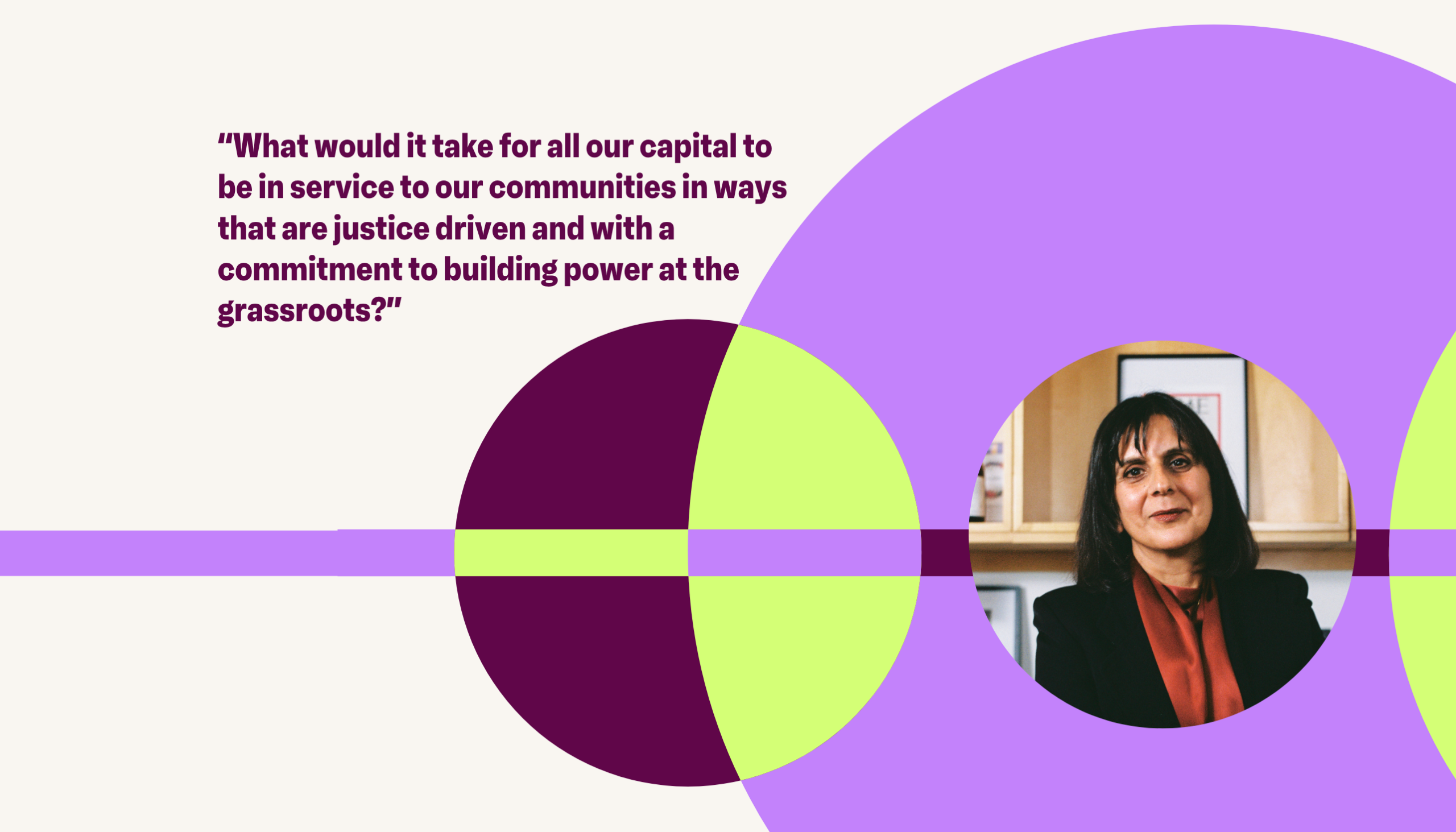
This paper is motivated by a question that is critical to the next iteration of Tudor’s strategy. What would it take for all our capital to be in service to our communities in ways that are justice driven and with a commitment to building power at the grassroots?
Tudor’s transformation began in 2024, with a redesign of our grant-making so that we could work alongside our grant partners in pursuit of systemic change. From the beginning, we built a learning lens to ensure our long-term strategies are designed through the ambitions of our partners.
We have faced the hard truth that those operating through racial justice have been deprived of long-term, large-scale funding. Rather than giving up, many organisations and their leaders have become determined and entrepreneurial in their approaches. Their experiences have motivated their ambitions to secure forms of capital and assets beyond grants, including land acquisition, community ownership models, and social enterprise.
At Tudor, we have learnt that grant-making alone will not build a strong, resilient civil society, or create pathways to community wealth building that is justice-led. With this in mind, we are also turning our attention to ways in which we can shift the flow of capital towards the grassroots. What would it take for finance to circulate in ways that are regenerative, and build community power and resilience in the longer-term? In
commissioning Amir Rizwan to write this paper, we have not asked him to answer this question on our behalf, but rather to help us deepen our focus on the contradictory role capital plays in either reinforcing extreme forms of inequity or in challenging it. We asked him to make more visible the complexities we must navigate, so that we can make informed choices and decisions in relationship with our communities.
The Tudor Trust has an endowment that is currently worth around £220m. Like many foundations, our investments are externally managed to generate financial returns, so that we have the annual income to make grants in line with our social goals. However, endowments cannot be managed as though they are neutral, when we know that every pound is active in the world – fueling industries, shaping markets, determining whose futures are made possible and whose are denied. Money is always doing something and in the systems Tudor currently invests in, that “something” is often reinforcing the very harms we seek to address. Many foundations have understood this and, like Tudor, have worked to invest responsibly, with a focus on environmental and social impact. Yet the reality is that wealth inequality has continued to widen, and the devastation of climate change and poverty reinforces that we have in no way done enough.
Tudor trustees have always enacted their stewardship responsibilities in ways that reflect their understanding of the challenges of the day. In our very inception in 1955, Tudor’s original deed states trustees are free to exercise ‘absolute and unfettered discretion’ in the distribution of ‘both capital and income’ for broad charitable purposes. Tudor has consistently spent more than our annual income, using portions of our capital to make grants and fund capital projects. Rather than being concerned with perpetuity, Tudor has always maintained its spend when trustees believe this is in the best interest of our mission – for example during the 2008 financial crash when endowments were hit, we focused on meeting the needs of communities.
It is now for this new iteration of Tudor trustees, in relationship with our partners, to address critical questions, that include spend out strategies, preservation of some of our capital, and other opportunities to achieve our goals and mission.
It is my role to engage with challenging questions which can guide our shared learning. I therefore encouraged Amir to write this paper to provoke us within philanthropy and beyond to step into discomfort and confront the difficult choices we must make. I am grateful to him for leaning into this challenge. The report that Amir has written does not necessarily reflect the official views of The Tudor Trust, as we are still working out our longer-term strategy. However, we must be ready to meet the growing demands made by our communities with a combination of care and urgency, so that racial justice and regenerative practices create the pathway to long-term thriving communities.
This is a public version of an internal paper, published in the spirit of being open to sharing our thinking and inviting others who are asking similar questions to join us on this journey.