Practising the world as it should be
Written by Holly Anderson-Whittaker, Learning & Knowledge Lead
At Tudor, we often speak about the world as it should be. For us, this is about the intentional shifts towards futures that are regenerative, abundant, liberatory, and collective. A world governed by communities of self-determination and shaped by intersectional approaches. We hold this vision whilst practicing, facilitating, learning, transforming and moving resources into communities informed by the critical connections within our ecosystem and its ongoing emergence.
Our ecosystem exists in recognition of our interdependence and that it is our values-aligned networks that will enable movements and communities to create deep and lasting change. Our non-separation is a practical reality, and we must lean into this through practice. Thinking about what this practice calls for- I revisited Practicing New Worlds- Abolition and Emergent Strategies by Andrea J. Ritchie. In the introduction, adrienne maree brown reflects:
“…it feels harder and harder to try on different strategies to resist and persist. It feels riskier to experiment; to reach for different ways of thinking, being and relating; to imagine and create conditions for something new to emerge. The more pressure we are under, the more urgency, uncertainty, and fear we face, the stronger our instincts to cling to the familiar.”
What we need to resist is widening and becoming more urgent. How we meet with this becomes very important- acknowledging it, processing it, and transforming it- into the energy we need to get us somewhere different. It is our connection to both people and practice(s) that will support us here, and I mean this broadly.
I have been sitting with the realities of philanthropies’ impact on movements – what it takes to embody the transformation needed to be part of a more abundant system, and what becomes possible when we truly build and shift power within our institutions.
What would it mean for us to acknowledge the consequences of philanthropies accepted norms regarding decision making, grant architecture, and scarcity and challenge ourselves to go deeper into the practice of intentional adaptation toward a more collective view of resource allocation and community self-determination.
The ecosystem, and its foundations, were always embodying the world as it should be- our work has been about surfacing this and applying this view to our resourcing – towards a more abundant approach.
Ecosystem mapping speaks to a wider exercise in recognising interdependence at all levels of movement building and systems thinking. We must recognise the challenges movements and communities have incurred through the sector’s approaches to social change and resourcing justice and adapt for movement abundance.
Movement abundance is about asking ourselves, ‘What else might be possible’ and how we take responsibility for practicing the world we believe must exist, in the spaces we hold as we build it together. This then returns us to non-separation.
As part of Working Courageously Into An Unknowable Future – a course I took part in facilitated by Joy Green, we were asked:
What happens when we develop our felt awareness of non-separation and lean into it?
Non-separation clarifies for me the importance of holding complexity, as we practice into the near futures we believe in. It speaks to our felt awareness of needing one another, of both people and planet.
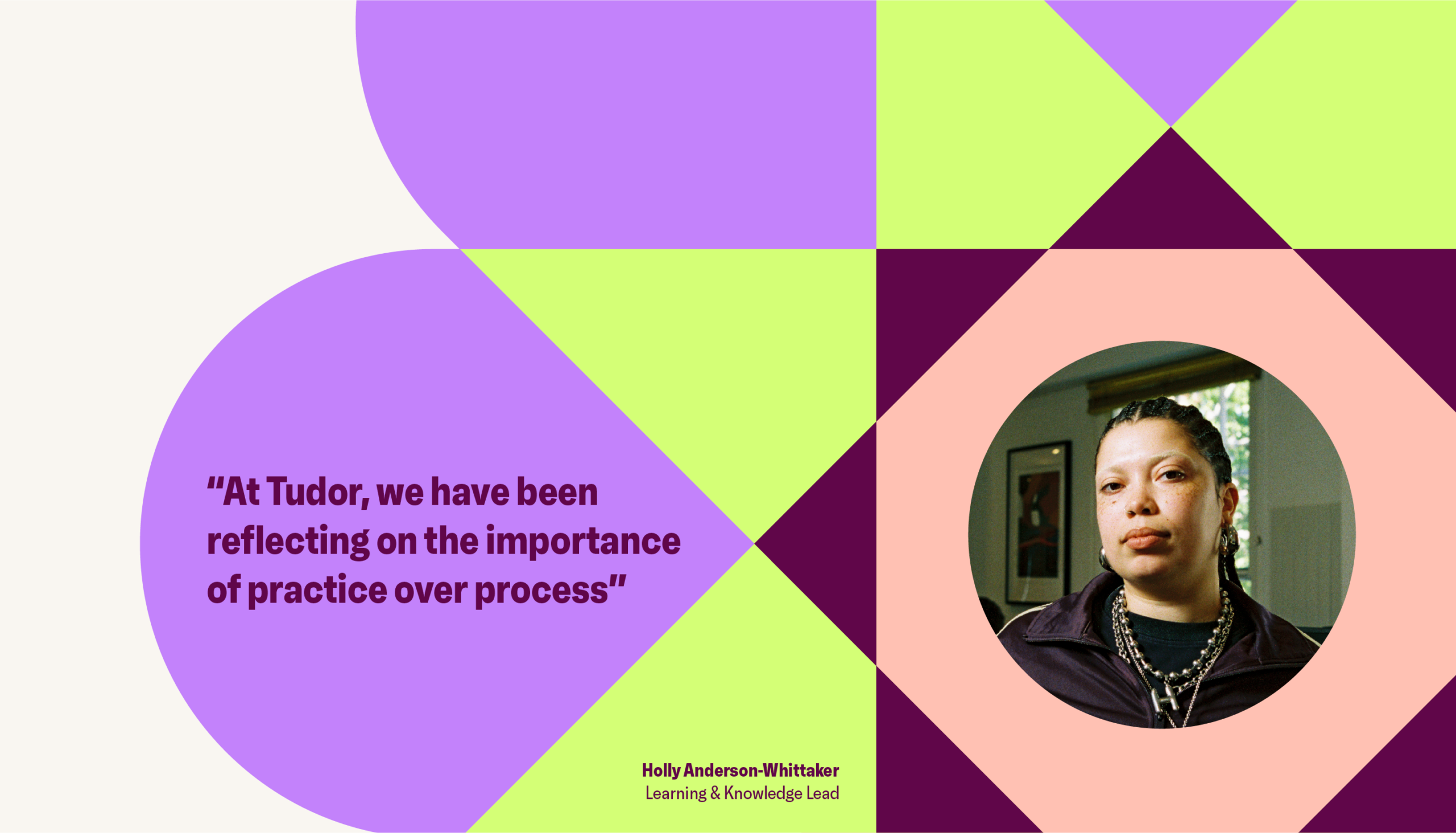
At Tudor, we have been reflecting on the importance of practice over process and noticing how easily we can slip back into ways of working that serve the system as it currently is. Process offers familiarity- but it also reinforces the assumption that the future will follow established patterns, leaving little room to interrupt or reshape what exists. In this way, it can quietly permit stagnation.
As a result, our creativity and imagination are quietened, but we can still recognise the longing for our systems to be different- maybe we tell ourselves we are waiting for the right moment, but that moment is right now, and it’s urging us to become more organised.
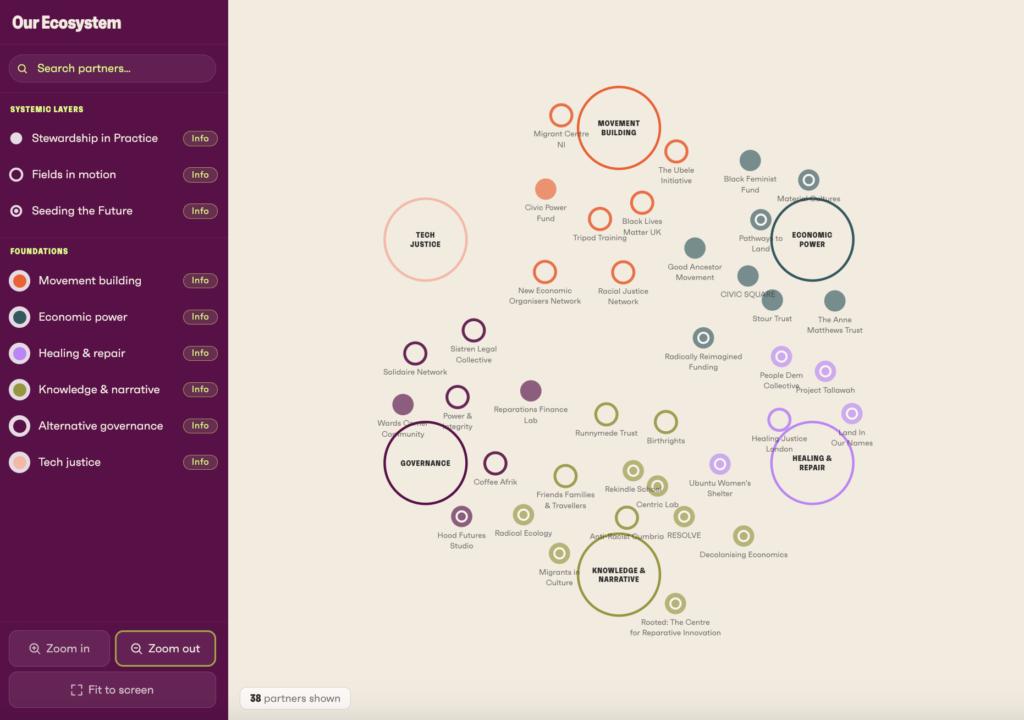
Ecosystem mapping engages our creativity- enabling us to hold greater complexity and deepen our capacity for generative dialogue and reciprocity. It’s a visual acknowledgement of the multiplicity of actors, knowledge systems, approaches, and work, that when seen together, reveals the pathways to new futures.
Applying this approach of mapping and ecosystems to our resourcing prompted deeper reflections about what we needed to acknowledge, how we envisioned the foundations of a new system working together, what the ecosystem needs and what it means to center it, and how we could lean into curiosity and embrace the unknown. It is understood as a natural system, which requires tending, attention and opportunity to grow and change.
Our ecosystem
Our ecosystem is currently understood through its two main components: Systemic Layers and Foundations of a New System.
Our Systemic Layers outline a characterisation of how this work operates as part of a just future – across all layers we see rooted and reaching work; that calls us towards futures that are abundant, regenerative, liberatory and collective. These are:

Stewardship in Practice (Harvest): This layer is situated in a grounded practice, where partners are stewarding wealth and assets through new forms of governance and leadership. These organisations provide an anchor for deep collaboration, demonstrating alternative ways of holding and exercising power.

Fields in Motion (Wind): This layer is found in movement building and shared infrastructure, bringing communities together so that they can strategise, convene and build power. It is about the key connectors who reduce fragmentation by centring relationships and enabling coordinated action.

Seeding the Future (Seeds): This layer operates at the margins of imagination and experimentation. These margins are not limitations but understood as emergent spaces where the work urges us towards new futures and ways of seeing. There is power in what can be possible here without forcing certainty or scale.
Foundations of a New System speak to the core areas of work and practice we understand as part of a new future system and the world as it should be. These currently include:
- Movement Building
Resourcing the connective tissue between organisations, strengthening relationships and building solidarity and collective power beyond siloed approaches. - Economic Power
Focuses on redistributing wealth through alternative ownership models and civic/community infrastructure, rewiring how assets are held and governed to build long-term economic resilience and community self-determination. - Healing & Repair
Resourcing caring infrastructures in organisations and communities through building deep connection and compassion to enable repair and accountability. These approaches recognise justice sitting at the center of healing and restoration. - Knowledge & Narrative
Investing in the stories, practices and wisdom that sustain movements, and the research, storytelling, cultural work and media that shape public understanding through community perspectives and knowledge exchange. These narratives enable imagination and create space for collective learning. - Alternative Governance
Centers accountability and transformative models of decision-making, embedding community-led governance systems that draw on examples such as feminist leadership and indigenous knowledge to shift power away from traditional hierarchies. In practising these alternatives, radical leadership models the world as it should be. - Tech Justice
Communities are resourced to shape, govern, and build digital infrastructures on their own terms for collective benefit, from organising tools to advocacy on the politics of data and algorithmic power.
As we shift towards this new practice, we will continue to ask the generative questions and seek the emergent answers that lend itself towards the hopeful future we believe exists in our line of sight. We will build these responses together.
Acknowledgements:
The act of citation serves as a way to remember and acknowledge communal memory, ancestral knowledge and wisdom that exists beyond our own.
Practicing New Worlds – Abolition and Emergent Strategies- Andrea J. Ritchie
Joyful Militancy – Building Thriving Resistance in Toxic Times- Nick Montgomery and carla bergman
Emergent Strategy- adrienne maree brown
Fugitive Feminism- Akwugo Emejulu
Working Courageously into an Unknowable Future, facilitated by Joy Green (January 2026)